
Table of Contents
- Why Verifying UTV Part Compatibility Matters
- Step 1: Gather Your Vehicle's Core Details (Make, Model, Year)
- Step 2: Confirm Engine Size and Displacement
- Step 3: Use UTV Part Number Cross Reference to Match Components
- Step 4: Check Your VIN for Fitment Data and Parts Lookup
- Step 5: Review Product Listing Details and Trim Specifications
- UTV Fitment Checklist Before You Order
- Common Mistakes to Avoid When Checking Part Compatibility
- Frequently Asked Questions
Last Updated: October 7, 2026
Why Verifying UTV Part Compatibility Matters
Ordering the wrong part is frustrating: it arrives, doesn't fit, and you're stuck with a return and a reorder delay.
The real cost isn't just inconvenience. A mismatched part can damage your UTV during installation and force modifications that void the warranty or create safety issues. Getting fitment right the first time saves money, time, and headaches.
Verify UTV part compatibility before you buy. It takes 10 minutes and prevents hours of frustration once you know what to check.
Step 1: Gather Your Vehicle's Core Details (Make, Model, Year)
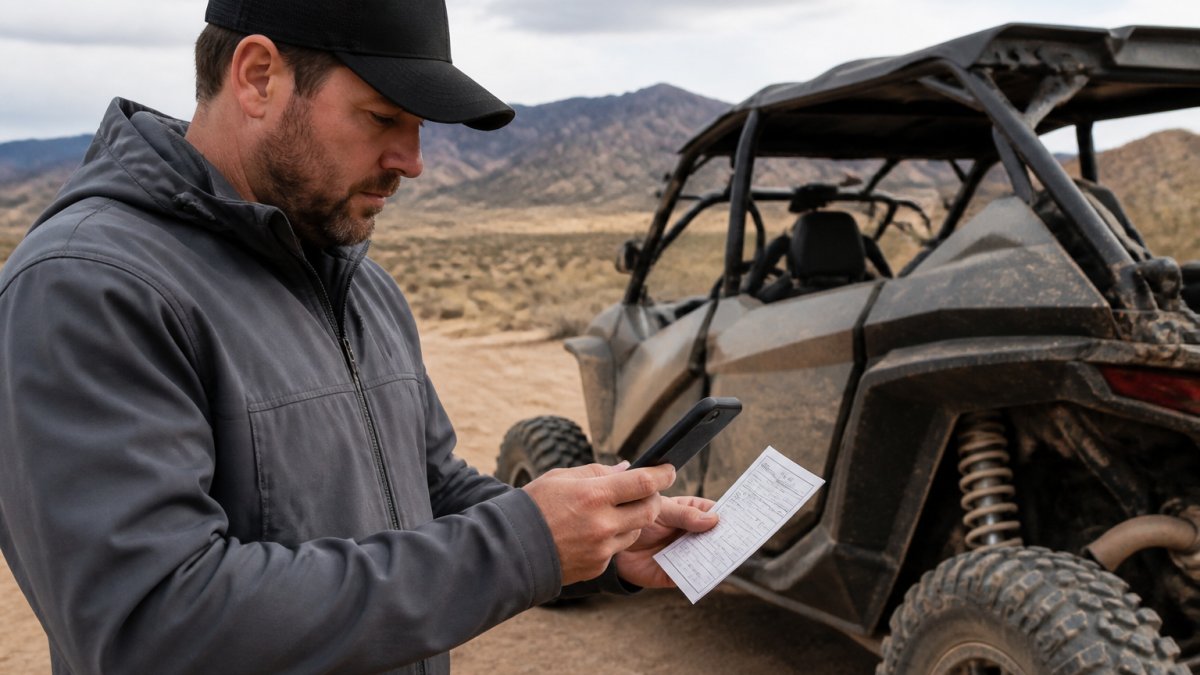
Every fitment check begins with knowing exactly what machine you own.
Write down your UTV's make (Honda, Kawasaki, Yamaha, Can-Am, Polaris, etc.), model (Rincon, Mule, Rhino, Outlander), and model year, the year on your registration and title, not the current year.
Your registration lists make, model, and year on the front. If it's not handy, check your insurance documents or the manufacturer's sticker on your UTV frame.
Why this matters: A 2019 Can-Am Outlander uses different parts than a 2020 model. The engine displacement might be the same, but internal components changed. Fitment depends on the exact year.
Many owners think "close enough" works. It doesn't. A part that fits a 2018 model might not fit a 2019, even from the same manufacturer, mid-year revisions are common.
Step 2: Confirm Engine Size and Displacement
Engine displacement, measured in cubic centimeters (cc) or liters, narrows down which parts will work.
Find your UTV's engine size on your registration or in your owner's manual. Look for numbers like 450cc, 650cc, 700cc, or 1000cc; some machines list liters instead (0.7L, 1.0L).
Why does this matter? A bearing kit for a 650cc engine won't fit a 700cc engine, mounting points and seal dimensions differ. The wrong size causes leaks, mechanical failure, or installation damage.

Check three places for engine size:
- Your vehicle registration
- Owner's manual (usually in the specifications section)
- The manufacturer's website (search your make and model year)
If you can't find it, a local UTV dealer can confirm your engine displacement in seconds.
Step 3: Use UTV Part Number Cross Reference to Match Components
Part numbers are your verification tool. Every component has a unique code that tells you exactly what it fits.
Find the part number on the product listing, an alphanumeric code like "AT-06633" or "25-2047" that tells you which vehicles the part fits.
Cross-reference the part number with your machine:
- Write down the part number from the product page
- Search that part number on the manufacturer's website
- Look at the vehicle applications list
- Find your make, model, and year
If your UTV appears in that list, the part is compatible. If it doesn't, keep looking.
Many parts work across multiple vehicle lines. The All Balls Racing product documentation shows fitment for dozens of models. When you cross-reference, you're checking the manufacturer's official compatibility chart.
Example: The Bronco AT-06633 rear wheel bearing kit fits Kawasaki Mule models from 2001 to 2020. If you own a 2015 Mule 4010, you search "AT-06633" and confirm your model year is listed. It is, so the part is verified compatible.

Step 4: Check Your VIN for Fitment Data and Parts Lookup
Your Vehicle Identification Number (VIN) is a 17-character code encoding your UTV's build information. On UTVs, VIN lookup works differently than for cars, knowing when it helps versus misleads is the difference between a confirmed fit and a returned part.
Where to find your UTV VIN:
- On your registration and title
- Stamped on the frame, usually near the steering column or on a frame rail
- On a manufacturer compliance label affixed to the frame
What a UTV VIN can actually tell you:
- The model year and assembly plant
- The base model designation
- The engine family or displacement class, in many cases
- The production sequence number, which can help identify early vs. late production within a model year
What a UTV VIN often cannot tell you:
- Dealer-installed accessories or trim packages added after delivery
- Aftermarket modifications (lift kits, big-bore kits, replacement harnesses)
- Mid-year engineering revisions that changed a bracket, connector, or mounting point without changing the VIN pattern
- Parts supersessions where the manufacturer replaced a component mid-cycle
This is the key UTV-specific limitation: automotive VIN decoders follow passenger-car data standards, and many UTV manufacturers don't publish the same depth of VIN-to-part mapping. A "no results" lookup usually means the tool's database doesn't cover your model year or brand.
When VIN lookup is worth using:
- Newer machines (roughly 2015 and later) where the manufacturer maintains a current fitment database
- OEM parts counters that can pull your build sheet from the VIN
- Retailers whose fitment tool is fed directly by the manufacturer, not a third-party aggregator
When to skip it and go straight to part numbers:
All Balls 25-2047 Rear Differential Bearing Kit for Honda Rincon →
- Older UTVs with incomplete VIN records
- Any machine that has been modified or accessorized
- Any time the VIN tool returns partial or ambiguous results
If your VIN lookup returns a clean match, treat it as one confirmation, not the only one. Cross-check the part number against the manufacturer's application list before you buy. If it returns nothing useful, move to Step 3 and verify by part number and application chart.
Step 5: Review Product Listing Details and Trim Specifications
The product page is where most fitment mistakes are caught, or missed. Read beyond the headline "fits" claim and check the details that determine whether the part will bolt on, plug in, and clear everything around it.
What to look for on the listing:
- A dedicated "Vehicle Fitment," "Compatibility," or "Applications" section
- The exact make, model, and year range, not just the model family
- Engine displacement or engine code, if the part is engine-specific
- Trim or submodel qualifiers (base, diesel, 4WD, special edition)
- Any installation notes, required tools, or modification warnings
Trim and submodel variations to verify:
- Engine type (gas vs. diesel)
- Transmission (automatic vs. manual)
- Drive system (2WD vs. 4WD)
- Cab configuration or bed style, where relevant
- Special editions or dealer packages that changed a component
Mid-year revisions and model-year changes:
A part can differ across model years even when the vehicle name is identical.
Physical interface checks when the catalog is unclear:
If the listing is ambiguous or your machine is modified, verify the physical interfaces directly:
- Bolt pattern and hole spacing, measure center-to-center on mounting holes and compare to the part
- Bearing or seal dimensions, inner diameter, outer diameter, and width
- Connector type and pin count, for electrical parts, match the plug shape and terminal count
- Shaft diameter and spline count, for drivetrain components
- Clearance, check that the part will not contact the frame, exhaust, or suspension through full travel
Fitment on modified or accessorized UTVs:
Lift kits, larger tires, aftermarket wheels, engine modifications, and prior repairs can all change what fits. A lift kit moves suspension mounting points; larger tires change clearance around fenders and control arms; an engine swap or big-bore kit changes displacement beyond the factory listing.
Return, warranty, and safety implications:
Before you buy, confirm the seller's return policy for fitment-related returns, whether the part carries a manufacturer warranty, and whether installing a non-specified part could affect your vehicle warranty or create a safety issue. A part that "almost fits" can fail under load.
UTV Fitment Checklist Before You Order
Use this checklist every time you buy a part. It takes five minutes and prevents costly mistakes.
| Verification Step | What to Check | Status |
|---|---|---|
| Make and Model | Does the product list your UTV's brand and model? | ☐ Confirmed |
| Model Year | Is your exact year included in the fitment list? | ☐ Confirmed |
| Engine Size | Does the part match your engine displacement (cc or liters)? | ☐ Confirmed |
| Part Number | Did you cross-reference the part number on the manufacturer's site? | ☐ Confirmed |
| Trim Level | If applicable, is your trim (2WD, 4WD, diesel) listed? | ☐ Confirmed |
| Installation Notes | Did you review any special installation requirements? | ☐ Confirmed |
| Return Policy | Do you understand the return process if something doesn't fit? | ☐ Confirmed |
Print this checklist or save it to your phone. Go through it before clicking "buy." One missing check often means a wrong part arrives.
Common Mistakes to Avoid When Checking Part Compatibility
Skipping the fitment check is the biggest mistake, but others catch even experienced builders.
Trusting product photos alone. A bearing kit looks the same whether it's for a 650cc or 700cc engine. Photos don't tell you if it fits.

Ignoring trim variations. Diesel and standard-engine models use different parts. Four-wheel-drive and two-wheel-drive machines have different suspensions. A part for one trim won't work on another.
Buying from sellers without fitment data. If a product page doesn't list compatible vehicles, don't buy from that seller. A legitimate retailer always provides fitment information.
Assuming OEM and aftermarket parts are interchangeable. Original equipment manufacturer (OEM) parts are made by the vehicle manufacturer. Aftermarket parts are made by third parties.
Skipping the installation requirements section. Some parts need special tools or modifications.
Verify UTV part compatibility using these five steps, and you'll order the right part the first time. Check your make, model, year, engine size, and part number.
At Updog Industries, we make this process easier. Every product includes complete fitment information and part number verification.
Frequently Asked Questions
Can you look up UTV parts by VIN?
Yes, a VIN lookup can provide your exact make, model, year, and trim information, which narrows down compatible parts significantly. However, VINs have limitations for UTVs, some manufacturers don't encode all trim or engine-size data in the VIN. Always cross-check VIN-derived information against your registration documents and the product listing to confirm exact fitment before ordering.
Which vehicle details do I need to check before ordering a UTV part?
You need the make, model, model year, engine size (displacement in cubic centimetres), and trim or submodel designation. Some parts also require the part number from your current component or your VIN. Check the product listing's compatibility section, it will specify exactly which details you need. If your trim isn't listed, contact support to verify fitment before purchasing.
How can I cross-reference part numbers to find similar parts?
Use the original part number from your UTV's service manual or existing component as a starting point. Search the part number in the product catalog or contact support with both your vehicle details and the part number. Aftermarket manufacturers often publish cross-reference charts showing which OEM part numbers their components replace, which helps verify compatibility across brands.
What should I do if a parts listing does not specify my UTV trim?
Contact support with your make, model, year, engine size, and VIN before ordering. Many parts fit multiple trim levels, but the listing may not enumerate every variant. Support can confirm whether the part is compatible with your specific trim and identify any installation differences or modifications needed for your configuration.