
Table of Contents
- What You'll Need Before You Start
- Step 1: Start With an Aftermarket Intake System
- Step 2: Add a Slip-On Exhaust and Reflash the ECU
- Step 3: How to Install a UTV Clutch Kit
- Step 4: Turbocharger Kits and Internal Engine Work
- UTV Engine Reliability Tips After Your Upgrade
- Legal and Emissions Compliance for Modified UTVs
- Conclusion
- Frequently Asked Questions
Last Updated: September 28, 2026
What You'll Need Before You Start
Upgrading UTV engine performance starts with an honest assessment of your machine, goals, and budget. This guide from Updog Industries covers the full path, from bolt-on intake and exhaust work to ECU tuning and internal builds.
Before you order a single part, gather these essentials:
- Service manual for your exact model and year
- Torque wrench calibrated in the correct range for clutch and head bolts
- Feeler gauges for valve clearance checks
- Compression tester to establish a baseline before modifications
- OBD or diagnostic tool compatible with your ECU
- Fresh gaskets, seals, and fluids for every component you touch
Step 1: Start With an Aftermarket Intake System
An aftermarket intake system is the logical first upgrade because it feeds every modification downstream. More airflow into the throttle body means more oxygen for combustion, which the ECU matches with additional fuel.
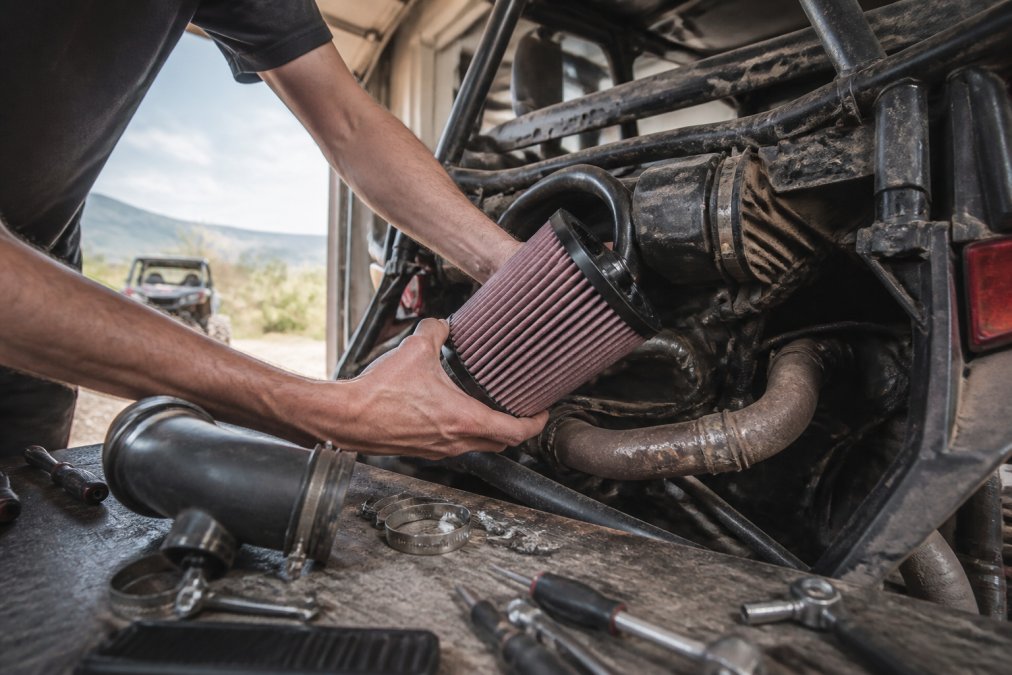
Choosing the Right Filter for Your Riding Conditions
Filter selection depends on where you ride, not on marketing claims.
| Riding Condition | Filter Type | Why It Fits |
|---|---|---|
| Dusty trails, desert | Oiled cotton gauze | High flow with strong particulate capture |
| Mud, water crossings | Foam pre-filter over main filter | Blocks water and heavy debris |
| Mixed trail and track | Dry synthetic media | Consistent flow, easy cleaning |
| Extreme dust, racing | Dual-stage foam | Maximum filtration for short service intervals |
Step 2: Add a Slip-On Exhaust and Reflash the ECU
A slip-on exhaust and an ECU reflash belong together. Adding exhaust flow without adjusting fuel mapping leans out the air-fuel ratio, raising combustion temperatures and shortening engine life. The reflash corrects that.
What a Reflash Actually Changes
An ECU reflash rewrites the fuel and ignition tables in your machine's computer. It is not a piggyback module that tricks sensors; it changes the actual mapping the engine runs on.
A good reflash adjusts:
- Fuel mapping across the RPM range to match your intake and exhaust flow
- Ignition timing for cleaner combustion and better throttle response
- Rev limiter settings, if your build supports higher RPM
- Cooling fan activation points, which matters on modified engines that run hotter
Step 3: How to Install a UTV Clutch Kit
Learning how to install a UTV clutch kit is one of the highest-value skills for any side-by-side owner. A clutch kit changes how the drivetrain delivers power to the ground, and on belt-driven machines it is often the biggest drivability improvement you can make.
Total time: 2-3 hours Difficulty: Intermediate
- Park on level ground, engage the parking brake, and disconnect the battery.
- Remove the clutch cover panel to expose the primary and secondary clutch.
- Inspect the belt for glazing, cracks, or fraying. Replace it if worn.
- Remove the primary clutch bolt and slide the clutch assembly off the shaft.
- Install the new spring, weights, and helix per the kit instructions.
- Reassemble the secondary clutch and torque all fasteners to spec.
- Reinstall the belt, cover, and battery connection.
- Test at low speed first, checking engagement RPM and shift smoothness.
Step 4: Turbocharger Kits and Internal Engine Work
Turbocharger kits push UTV engine performance into a different category. Forced induction delivers large horsepower and torque gains, but it also raises cylinder pressure, heat, and stress on every internal component. Understanding those stresses separates a build that lasts from one that fails on the third ride.
What a Turbo Actually Does to Your Engine
A turbocharger uses exhaust gas to spin a turbine that compresses intake air. Denser air carries more oxygen, so the ECU adds more fuel and makes more power from the same displacement. The trade-off is heat and pressure: compressing air raises its temperature, burning more fuel raises combustion temperature further, and cylinder pressure climbs, loading the head gasket, head bolts, pistons, and rods far beyond factory design.
The Supporting Upgrades a Turbo Requires
Before you bolt on a turbo, understand what has to change with it:
- Compression ratio often needs lowering with forged pistons. Stock pistons are typically cast and not designed for boost. Forged pistons handle higher cylinder pressure and heat without cracking ring lands.
- Head bolts should be upgraded to handle higher cylinder pressure. Stock bolts can stretch under boost, which lifts the head and blows the gasket. ARP-style studs are the common upgrade.
- Fuel system must supply enough volume and pressure for boost. A stock pump and injectors may run out of capacity at higher RPM, causing a lean condition that melts pistons. Upgraded injectors, a higher-flow pump, and sometimes a rising-rate fuel pressure regulator are part of the package.
- Cooling system needs capacity to shed the extra heat. A larger radiator, upgraded fan, and sometimes an intercooler to cool the compressed air before it enters the engine are common additions.
- Drivetrain components must handle the added torque without snapping. CVT belts, clutches, axles, and differentials all see more load. A clutch kit matched to the new power curve is not optional.
- ECU tuning must be redone for boost. A reflash built for a naturally aspirated engine will not deliver the right fuel and ignition timing under positive manifold pressure.
Lower End Torque Improvements Without a Turbo
Not every rider wants boost. Lower end torque improvements come from displacement changes, cam profiles, and head work. A big-bore kit increases displacement and torque across the RPM range without the heat and complexity of forced induction. Camshafts with more lift and duration shift the power band, and ported heads improve flow. These are engine-out jobs requiring precision machining and careful assembly, if you lack bottom-end experience, hand this stage to a machine shop.
Reliability vs. Performance: The Trade-Off Nobody Talks About
Reliability versus performance is the central trade-off here, and most guides skip it because it does not sell parts. A turbo build making big power on stock internals will not last like a naturally aspirated engine with bolt-ons. The more power you extract, the shorter the service intervals and the higher the chance of a ride-ending failure. Decide what you actually need before you spend.
UTV Engine Reliability Tips After Your Upgrade
Reliability tips after an upgrade come down to maintenance discipline and honest monitoring. Modified engines wear faster than stock ones, and the schedule that worked before your build will not protect it now. More power means more heat, more cylinder pressure, and more stress on every component, the factory intervals were written for a stock engine, so once you change that, the intervals change too.
Why Modified Engines Fail Sooner
Three mechanisms drive most post-upgrade failures:
- Heat. More fuel burned means more heat rejected to the oil and coolant. Oil breaks down faster at higher temperatures, and coolant systems that were adequate for stock power may not keep up.
- Lean conditions. If the air-fuel ratio leans out under load, combustion temperatures spike and can melt pistons or burn valves. This is the most common cause of sudden failure after a reflash or turbo install.
- Fastener stretch. Higher cylinder pressure loads head bolts and clutch bolts beyond their original design. Bolts that were fine at stock power can stretch, causing gasket leaks or clutch slippage.
Understanding these mechanisms tells you what to monitor.
A Prioritized Maintenance Schedule for Modified UTVs
Follow these habits, ordered by how much they protect your investment:
- Monitor air-fuel ratio if you run a gauge. This is the single most important habit on a modified engine. Lean conditions destroy pistons, and a gauge tells you before damage happens. If you see elevated temperatures or hear detonation, stop riding and diagnose before you continue.
- Change oil more often than the factory interval, especially on turbo builds. Heat breaks oil down faster. Many builders halve the interval on forced-induction machines.
- Check the cooling system for leaks, low fluid, and fan operation before every ride. Modified engines run hotter, and a marginal cooling system becomes a failure point.
- Clean or replace your air filter based on hours ridden, not calendar time. A dirty filter restricts flow and can cause a rich condition that washes oil from cylinder walls.
- Inspect the belt and clutch for wear every few rides. Added torque accelerates belt wear and can glaze clutch sheaves.
- Retorque critical fasteners after the first heat cycle on any new install. Head bolts, clutch bolts, and exhaust flange bolts all settle after the first heat cycle.
The Reliability vs. Performance Trade-Off
Every upgrade trades something for something else. A machine making 30% more power will not last as long as a stock one on the same maintenance schedule, and no amount of care changes that. What care does is extend the life you get from the power you built. Riders who get the most from their machines accept the trade-off and maintain accordingly, rather than treating a modified machine like a stock one.
Legal and Emissions Compliance for Modified UTVs
Emissions and legal compliance vary widely by state and land management agency, and most upgrade guides skip this entirely. Modifying your exhaust or removing emissions equipment can make your machine illegal for certain trails, even if it runs better.
Before you modify anything emissions-related, check:
- Your state's registration and inspection rules for off-road vehicles
- Federal land agency requirements for the trails you ride
- Sound level limits, which many trail systems enforce strictly
- Spark arrestor requirements, mandatory on most public lands
Conclusion
Every upgrade on this list trades something for something else, and riders who get the most from their machines plan the whole build before buying the first part. Intake, exhaust, reflash, and clutch work deliver the best balance of performance and reliability for most trail and track riders. Turbo and internal engine work deliver more, but only when the supporting systems keep pace.
Frequently Asked Questions
What are the most effective ways to increase UTV horsepower?
The most effective path starts with airflow: an aftermarket intake system and slip-on exhaust free up breathing, then an ECU reflash adjusts fuel mapping to match. From there, a clutch kit improves how that power reaches the ground. For bigger gains, turbocharger kits or internal work like cam and head bolt upgrades deliver the largest numbers, but they also demand more supporting modifications and stricter maintenance.
Do UTV engine upgrades void the manufacturer warranty?
Most manufacturers void or limit warranty coverage on powertrain components once you install aftermarket performance parts, especially ECU reflashes and internal engine mods. Bolt-ons like intake systems and exhausts sometimes fall into a gray area, but any modification that alters fuel mapping or compression typically triggers a warranty exclusion. Check your specific warranty terms before ordering, and keep receipts for any parts you install.
How does an ECU tune improve UTV engine performance?
A reflash rewrites the factory fuel and ignition tables to match your hardware changes. Stock maps run conservative air-fuel ratios and timing to handle varying fuel quality and altitude. Once you add an intake or exhaust, the factory map can't take advantage of the extra airflow. A proper tune adjusts fuel delivery and timing to produce more horsepower and sharper throttle response, particularly in the mid-range where trail riders spend most of their time.
What is the difference between bolt-on upgrades and internal engine mods?
Bolt-ons include intake systems, exhausts, clutch kits, and tuners. They install with hand tools in a few hours and are reversible. Internal mods require opening the engine: camshafts, pistons, head bolts, and compression changes. These deliver larger horsepower gains but cost significantly more, demand precise torque specs, and increase the risk of reliability issues if the supporting fuel and cooling systems aren't upgraded to match.