
Table of Contents
- Understanding Powersports Return Policies
- Step 1: Check Return Eligibility and Time Limits
- Step 2: Verify Item Condition Requirements
- Step 3: Prepare Your Return Request
- Step 4: Understand Powersports Parts Return Policy
- Step 5: Manage Return Shipping and Costs
- Step 6: Powersports Returns and Exchanges Process
- Step 7: Know About Powersports Restocking Fees
- Frequently Asked Questions
Last Updated: October 18, 2026
Understanding Powersports Return Policies
Understanding powersports return policies for parts and accessories can feel overwhelming, but learning the key rules makes the process straightforward.
A powersports return policy is the set of rules that governs whether you can send back parts, accessories, or components after purchase, and under what conditions you'll receive a refund or exchange.
These policies prevent abuse while protecting legitimate customers: sellers need assurance that returned items are genuinely defective or wrong, and buyers need a reasonable window to catch mistakes.
Step 1: Check Return Eligibility and Time Limits
Your return window starts the moment your order arrives. Most powersports retailers offer a return window between 30 and 90 days from the delivery date, though some policies are stricter. The key is knowing your exact deadline before you need it.
Return windows by product category
Different product categories have different return windows. Here's what you'll typically encounter:
- Engine components and performance parts: 30-50 days from delivery
- Maintenance items and consumables: 14-30 days from delivery
- Accessories (grips, mirrors, plastics): 30-90 days from delivery
- Apparel and safety gear: 30-60 days from delivery
- Used or installed parts: Often non-returnable or restricted
The reason is practical: engine components are harder to inspect for hidden defects, consumables like oil or filters can't be resold once opened, and accessories are easier to verify.
Calculating your return deadline
Don't rely on memory. Write down your delivery date the moment your package arrives, then count forward. If your policy says "30 days from delivery date" and you received your part on October 1st, your deadline is October 31st.
Many retailers calculate deadlines from the shipment date, not the delivery date. Check your order confirmation email for the exact wording, if it says "30 days from shipment date," you have less time than you think.
Step 2: Verify Item Condition Requirements
The condition of your returned item directly determines whether you get approved. Most retailers won't accept returns on used, damaged, or altered parts. Understanding what "new condition" actually means prevents rejection.
What 'new condition' actually means
New condition means the item must be unused, uninstalled, and in the exact state it shipped. This includes:
- No visible wear, scratches, or marks
- All original packaging intact (box, wrapping, protective materials)
- All tags attached (if applicable)
- All included instruction manuals or documentation included
- No signs of installation or testing
Sellers enforce this because they can't resell a part that looks used, even if it works perfectly, a returned part gets restocked and sold to another customer.
Returning defective motorcycle parts
Defective parts are the exception to the "new condition" rule. If your motorcycle part arrived broken, bent, or non-functional, you can return it even if the packaging is opened.
Document the defect immediately with photos of the damaged area from multiple angles, the serial number (if visible), the original packaging, and the part next to a ruler for scale.
Step 3: Prepare Your Return Request
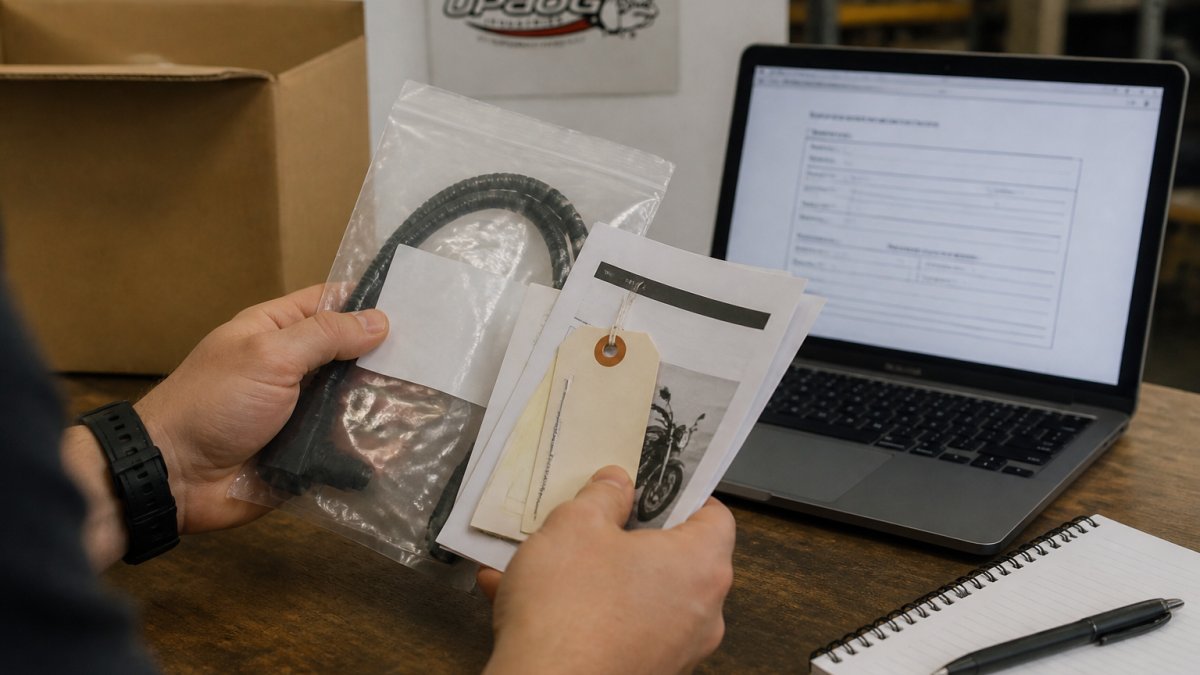
Before you ship anything back, get written authorization. An unauthorized return might get lost or rejected at the warehouse; authorization gives you tracking and proof that the seller expected your return.
Documentation you'll need
Gather these items before contacting the seller:
- Your original order number
- The product name and part number
- Your proof of purchase (order confirmation email)
- Photos of the item and packaging (if applicable)
- Photos of any defects (if applicable)
Having this ready speeds up authorization, sellers can approve your return in minutes instead of hours.
Requesting return authorization
Contact the seller's customer service team through their website, email, or phone. Explain your situation clearly and provide your order number.
Most retailers email a return shipping label within 24 hours with the warehouse address and your unique tracking number.
Never ship a return without an RMA number, it's your proof the return is legitimate.
Step 4: Understand Powersports Parts Return Policy
Powersports parts return policies vary significantly depending on what you're returning. A motorcycle part policy differs from an ATV accessory policy. Understanding these differences prevents rejected returns.
Differences across vehicles, parts, and accessories
Different product types have different rules:
- Motorcycle parts: Stricter policies due to safety concerns. Brake components, suspension parts, and engine parts often have shorter return windows (14-30 days) and require verification that they're unused.
- ATV and UTV parts: Slightly more flexible. Powersports enthusiasts often test components before committing, so some retailers allow 60-day windows. Mileage limits may apply (e.g., 500 miles maximum before return eligibility is forfeited).
- Accessories: Most flexible category. Grips, mirrors, plastics, and cosmetic items typically have 60-90 day windows and fewer condition restrictions.
- Apparel and protective gear: Often final sale or 30-day returns only. Once worn, most retailers won't accept returns for sanitary reasons.
The reason is liability: a failing motorcycle brake component could cause injury, an ATV fender is lower risk, and protective gear has hygiene concerns.
Used or installed parts
Used or installed parts are almost always non-returnable. Once a part has been bolted onto your machine, it's considered used. Even if you removed it carefully and it works perfectly, most sellers won't accept it back.
The exception is a defective part. If you installed a part and it failed within the return window, contact the seller immediately with photos, many retailers will accept a return claim and send a replacement, even for installed parts.
Step 5: Manage Return Shipping and Costs
Return shipping costs depend on your specific retailer and the reason for your return. Understanding who pays for shipping prevents surprise expenses.
Who covers shipping expenses
The rule is simple: if you caused the return (wrong size, changed your mind), you typically pay for return shipping.
Some retailers provide a prepaid return label; others require you to pay upfront and seek reimbursement after approval.
Updog Industries offers 100% free shipping sitewide on all orders with no minimum thresholds.
Tracking and proof of delivery
Use a tracked shipping method for all returns, USPS Priority Mail, UPS Ground, or FedEx Ground. Untracked mail leaves you with no proof the package arrived.
Keep your tracking number and the carrier's receipt, and photograph the label before sealing the box.
Some warehouses take 5-10 days to scan a package in, so don't panic if tracking goes quiet.
Step 6: Powersports Returns and Exchanges Process
You have two options when returning a part: request a refund or request an exchange. Understanding the difference helps you choose the right path.
Exchange versus refund decisions
An exchange means you send back the original part and receive a replacement. A refund means you send back the part and get your money back.
Choose an exchange if:
- The part you received was defective
- You ordered the wrong size and know the correct one
- You want to try a different brand or model
- You want to upgrade to a higher-performance version
Choose a refund if:
- You've changed your mind about the purchase
- You no longer need the part
- You want to shop around for a better deal
- You're unsure what to order next
Exchanges typically process faster than refunds: the warehouse can swap parts without waiting for payment processing, which adds 7-14 days to a refund.
Refund approval and payment timelines
Once the warehouse receives your return, they'll inspect it within 3-5 business days to verify it matches your order, is in acceptable condition, and is returnable. If approved, they'll process your refund.
Refund timelines depend on your payment method:
- Credit card: 5-10 business days (the card company's processing time)
- Debit card: 7-14 business days (banks are slower)
- PayPal or digital wallet: 2-5 business days
- Check or store credit: 10-14 business days (if offered)
The retailer's refund clock starts when they approve your return, not when they receive it, so if your part arrives on day 3 and they inspect it on day 5, you might not see money until day 15 or later.
Step 7: Know About Powersports Restocking Fees
Some retailers charge a restocking fee when you return an item. This is a percentage of your purchase price that the seller keeps to cover handling costs.
When restocking fees apply
Restocking fees typically apply when:
- You're returning an item for a reason other than defect (change of mind, wrong size, etc.)
- The item is in acceptable condition but has been opened or inspected
- The return is outside the retailer's standard return window
- You're returning a high-value item (engine components, suspension kits)
Restocking fees do NOT apply when:
- The part arrived defective
- The wrong item was shipped
- The part is incompatible with your machine (seller error)
- The return is within the standard window and the item is unused
Check your retailer's policy before ordering. Some charge restocking fees on all non-defective returns. Others waive them for first-time returns or loyalty customers.
Fee percentages and exceptions
Restocking fees typically range from 10% to 20% of your purchase price. A $100 part might cost $10-$20 to return.
Common exceptions to restocking fees:
- Defective or damaged items
- Wrong item shipped
- Items returned within 14 days of purchase
- Loyalty or VIP customers
- Returns initiated by the retailer (recall, discontinued item)
Read the fine print before accepting a restocking fee.
Handling a powersports return doesn't have to be stressful. Know your deadline, document the item's condition, get written authorization, and ship with tracking.
Frequently Asked Questions
How long do you have to return powersports parts?
Return windows vary by retailer and product category. Most powersports retailers allow 30 to 90 days from your purchase or shipment date, though some set different deadlines for vehicles versus parts and accessories. Check your receipt or order confirmation for the exact return deadline. Many retailers postmark the return deadline on the box label. If you're unsure, contact the seller before your window closes to confirm eligibility.
What condition do motorcycle parts need to be in for a return?
Most retailers require returned motorcycle parts to be in new, unused, unopened condition with original packaging and tags intact. This means the part must never have been installed, modified, or tested on your machine. If packaging is damaged or missing, the return may be rejected or subject to a restocking fee. Defective parts discovered before use are exceptions and typically qualify for returns or exchanges regardless of condition.
Are restocking fees common for powersports returns?
Yes, restocking fees are standard across the powersports industry. Most retailers charge 10% to 25% of the purchase price for change-of-mind returns of unused parts and accessories. Defective items, incorrect shipments, or parts damaged in transit are usually exempt from restocking fees. Some retailers waive fees for exchanges or offer full refunds within a shorter window. Always review the powersports restocking fee policy before ordering to understand potential deductions.
Who pays for return shipping on powersports parts?
Return shipping costs depend on the reason for the return. For change-of-mind returns, the customer typically covers shipping unless the retailer offers free returns as a promotion. For defective parts, incorrect shipments, or retailer errors, most sellers cover return shipping. Some retailers provide prepaid return labels. Always confirm who pays before shipping your part back to avoid unexpected costs. Track your shipment to ensure proof of delivery for refund processing.