
Last Updated: October 23, 2026
Quick Summary
To avoid backordered powersports parts, verify availability before ordering by calling your dealer directly, checking the exact OEM part number, and asking about lead times and regional warehouse stock. Plan maintenance ahead of time and order wear items on a schedule rather than waiting for failure, which eliminates most emergency part needs.
- Call your dealer and ask three specific questions: do you have it on the shelf, what's the manufacturer's lead time, and can you see it in the regional warehouse.
- Use a dealer-to-dealer network search to find the same part at other dealers who may transfer it to you within days.
- Replace wear items like brake pads, chains, and filters on a maintenance schedule before they fail, rather than ordering them in an emergency.
- Consider compatible aftermarket alternatives when OEM parts are backordered, as they often ship immediately and work just as well.
Table of Contents
- Why Powersports Parts Go on Backorder
- How to Check Motorcycle Parts Inventory Before Ordering
- Understanding Aftermarket Parts Compatibility for Your Machine
- Dealer-to-Dealer Inventory Networking and Alternative Sourcing
- Managing Powersports Parts Shipping Delays and Lead Times
- What to Do If Your Motorcycle Parts Order Gets Cancelled
- Proactive Maintenance Scheduling to Reduce Emergency Part Needs
- Frequently Asked Questions
Why Powersports Parts Go on Backorder
Backordered powersports parts happen for predictable reasons. Supply chain disruptions, seasonal demand spikes, and manufacturer delays are the main culprits. When a popular model year launches or racing season kicks in, dealers and distributors get hammered with orders simultaneously, and parts run out fast.
Logistics adds another layer. A single component might travel through multiple warehouses before reaching your dealer, and if one link breaks, your order stalls. Transportation delays, warehouse bottlenecks, and component sourcing issues all contribute.
The real insight most people miss: backorders aren't random. They follow patterns. Knowing which parts get stuck and when demand peaks lets you plan ahead, source alternatives, or adjust your maintenance schedule.
How to Check Motorcycle Parts Inventory Before Ordering
The best way to avoid backordered powersports parts is to verify availability before you commit. Don't assume a part is in stock because it appears on a website. Inventory systems vary wildly, and "available" can mean anything from "on our shelf" to "we'll order it and hope."
Start by calling your local dealer directly. A quick conversation beats clicking "add to cart" and discovering two weeks later that your order got cancelled. Ask specifically about lead time, a part can be "available" but take three weeks to arrive from the warehouse distribution center.
The Real-Time Inventory Check Workflow
Most riders stop at "call the dealer." That's step one of five. Here's the full sequence:
- Get the exact OEM part number from your machine's parts fiche (the exploded diagram in your service manual or the manufacturer's online parts catalog). Never search by description alone, "front brake pad" returns dozens of results and you'll waste time on the wrong one.
- Call your primary dealer and ask three questions: Do you have it on the shelf right now? If not, what's the manufacturer's current lead time? Can you see it in the regional warehouse? A dealer who can answer all three has a real inventory system.
- Check the manufacturer's dealer locator to find secondary dealers within a drivable radius. Many OEMs show which dealers stock which part categories, though few show live unit counts.
- Use aftermarket distributor stock checkers for common wear items. Major distributors publish live stock status, and some let you filter by warehouse region to see whether the part ships from a facility near you.
- Confirm the SKU and order number in writing before payment. Dealers sometimes list parts as in stock when they're pending receipt from manufacturers.
Digital Inventory Tracking Tools Worth Knowing
A handful of platforms let you check regional stock without calling every dealer in a 200-mile radius. Manufacturer dealer portals aren't public, but several aftermarket distributors and parts marketplaces expose live stock status by warehouse.
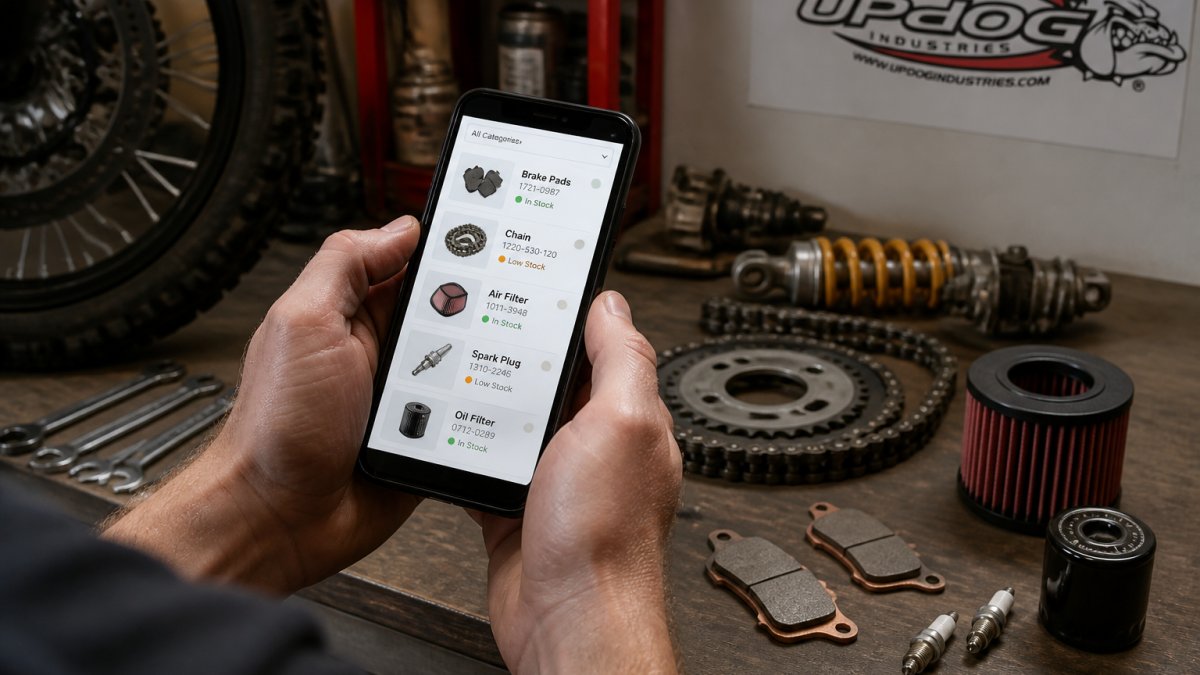
At Updog Industries, we provide a curated selection of premium, race-proven components from industry-leading brands. We are committed to transparency and value, offering 100% free shipping sitewide with no minimum order thresholds.
Understanding Aftermarket Parts Compatibility for Your Machine
Aftermarket substitution is a powerful tool most riders overlook. When an OEM part is backordered, an aftermarket alternative often works just as well and ships immediately.
OEM parts come directly from the original equipment manufacturer and are engineered specifically for your machine.
Compatibility depends on three factors:
- Physical dimensions and mounting points
- Performance specifications for your use case
- Brand reputation and quality standards
A wear item like a brake pad or air filter usually has many compatible aftermarket options. A precision component like a carburetor or suspension part requires more research.
The real advantage of aftermarket parts: you avoid the backorder problem entirely. While other riders wait months for OEM components, you're already riding with a proven alternative.
Dealer-to-Dealer Inventory Networking and Alternative Sourcing
Your local dealer isn't the only source for parts. A dealer-to-dealer inventory network exists specifically to solve backorder problems. When one dealer runs short, they can tap other dealers to source parts quickly, but only if someone runs the search. Most riders never ask, so they wait months for a part sitting on a shelf three hours away.
How Dealer Networks Actually Work
Dealers within the same brand typically share a common inventory portal. When your service advisor searches a part number, the system can show which other dealers have it on hand, how many units, and whether they'll transfer. Transfers happen two ways: a dealer-to-dealer transfer (ships between dealerships, often in a few days) or a customer pickup (you drive and buy it directly, faster if the distance is reasonable). Some brands also run regional warehouses; a part backordered locally may be sitting in a distribution center with a one-week replenishment cycle.
The Exact Ask That Gets Results
Don't walk in and say "can you check if anyone has it." Give the service advisor the OEM part number and ask these three questions in order:
- Can you run a network search on this part number and tell me which dealers show quantity on hand? This forces a real system query.
- If another dealer has it, will they do a dealer transfer, and what's the typical transit time? Most dealers will transfer without charging extra, but transit time varies by distance and shipping method.
- If no dealer has it, can you check the regional warehouse and give me the next replenishment date? This tells you whether waiting is measured in days or months.
Alternative Sourcing Strategies Beyond the Dealer Network
When the dealer network comes up empty, widen the search:
- Regional warehouse distribution centers that serve multiple dealers often carry deeper stock than any single dealership and can ship to your dealer on a regular replenishment schedule.
- Direct manufacturer ordering works for some components, especially if the OEM sells direct or through a factory parts program. Lead times are usually longer but the part is guaranteed genuine.
- Authorized aftermarket distributors frequently have faster lead times than OEM channels for common wear items, and many publish live stock status by warehouse.
- Salvage and used-parts networks are a legitimate option for non-wear components like bodywork, brackets, and controls, where a used OEM part in good condition beats waiting months for new.
Why Most Riders Never Use This
The key is asking. Many riders don't realize this option exists, but your service department can access inventory across a much wider network than you can find online. A single call to the right person often solves a backorder in days instead of months. Riders who avoid backorder frustration aren't luckier, they've learned to ask for a network search before accepting a "backordered" answer.
Managing Powersports Parts Shipping Delays and Lead Times
Shipping delays and lead times are different problems, and conflating them costs you time. Lead time is how long a part takes to be manufactured and delivered to the dealer.
Understanding the difference changes how you plan. If a part normally has a two-week lead time, expect it in fourteen days.
Always ask for a specific delivery estimate, not just "in stock" or "available." Get a date. If the part doesn't arrive by then, follow up. Dealers sometimes forget to chase orders.
Seasonal demand creates predictable lead time increases. Racing season and winter maintenance periods hit the supply chain hard. Plan around these peaks.
What to Do If Your Motorcycle Parts Order Gets Cancelled
Order cancellations happen. A part you thought was available turns out to be backordered or discontinued. The worst feeling is discovering this days after you ordered and paid.
First, understand why it got cancelled. Contact the dealer or distributor immediately. Ask if the part is truly unavailable or just delayed. Sometimes a cancellation is temporary.
If cancellation is permanent, you have options:
- Request a full refund immediately
- Ask about alternative parts that serve the same function
- Explore aftermarket substitutes the dealer recommends
- Check if another dealer can source the OEM part
Document everything. Get the cancellation reason in writing, and if you paid upfront, confirm the refund timeline. Most reputable dealers process refunds within five to seven business days; dragging feet is a red flag.
Legal rights around cancellation vary, but most dealers will refund you without hassle if you ask promptly.
Proactive Maintenance Scheduling to Reduce Emergency Part Needs
The best way to avoid backordered powersports parts is simple: don't need them in an emergency. Proactive maintenance scheduling prevents most parts from becoming urgent.
Maintenance isn't glamorous, but it's the most effective backorder prevention strategy available. Worn components fail predictably: a thin brake pad needs replacing, a stretching chain will snap, a clogged air filter will choke your engine.
Build a maintenance calendar for your machine. Track when major components typically wear out. Replace them before they fail. This approach has huge benefits:
- You avoid emergency parts orders
- You eliminate the backorder problem entirely
- You catch small issues before they become expensive failures
- Your machine runs better year-round
Wear items like brake pads, chains, filters, and spark plugs should be replaced on a schedule, not when they break.
Track your maintenance history, when you replaced each part and the hours or miles on the machine.
At Updog Industries, our 100% free shipping means you can stock up on common wear items without worrying about minimum orders.
Backordered powersports parts don't have to derail your riding season. The strategies here address the root causes: poor planning, unclear inventory visibility, and reactive ordering.
Frequently Asked Questions
What is a backordered part and why does it happen?
A backordered part is one that a retailer has sold out of but can reorder from the manufacturer. Backordered powersports parts occur due to supply chain disruptions, seasonal demand spikes, manufacturer delays, or unexpected popularity of specific components. Lead times can stretch from weeks to months depending on the part's origin and current logistics constraints. Understanding why a part is backordered helps you decide whether to wait or explore alternatives.
How can I check whether a powersports part is in stock before ordering?
Most reputable retailers display real-time inventory status on product pages, look for 'in stock,' 'limited quantity,' or 'backorder' labels. Contact the service department or sales team directly if the status is unclear, especially for OEM parts or hard-to-find components. Ask for a specific restock date and lead time estimate. Checking inventory tracking systems before committing to an order saves time and frustration later.
Are aftermarket powersports parts a good alternative to backordered OEM parts?
Aftermarket parts can work well if they match your machine's specifications and compatibility requirements. Verify that the component is designed for your exact make, model, and year before purchasing. Aftermarket alternatives often have shorter lead times since they're sourced from different suppliers than OEM parts. However, confirm warranty coverage and fitment guarantees, not all aftermarket options deliver the same performance or durability as original equipment.
Can I cancel a backordered motorcycle parts order?
Most retailers allow order cancellation before the item ships, but policies vary. If a part is already backordered when you place your order, contact the seller immediately to confirm cancellation terms and any potential restocking fees. Some dealers offer full refunds, while others may charge a small percentage. Review the return policy before ordering, and don't assume you can cancel without penalty once a backorder is placed.
