
Table of Contents
- What Makes Free Shipping Parts Actually Valuable
- Free Shipping vs Paid Shipping: The Real Cost Difference
- How to Compare Parts Prices Across Sellers
- Parts Shipping Time: Speed Trade-offs and Delivery Expectations
- Parts Return Shipping Costs and Warranty Claims
- Heavy and Oversized Parts: When Free Shipping Saves the Most
- The Break-Even Calculation: When Free Shipping Justifies the Wait
- Conclusion
- Frequently Asked Questions
Last Updated: October 5, 2026
What Makes Free Shipping Parts Actually Valuable
When you shop for powersports parts, the sticker price tells only half the story. Free shipping parts can save you real money, but only if you know what you're comparing.
The real question is whether total cost, price plus delivery time plus return risk, makes sense for your situation.
Free shipping parts are worth it when weight, timeline, and return policy align in your favor, and not when a hidden markup covers that "free" cost or the delay creates bigger problems than it solves.
Free Shipping vs Paid Shipping: The Real Cost Difference
The gap between free and paid shipping isn't always what it looks like at checkout. A fork rebuild kit at $89.29 with free shipping and another at $79 plus $15 shipping both cost $89.29, but only one appears free.

The real difference shows up in total landed cost, the final amount that leaves your account from click to delivery. A complete comparison has five line items:
- Item price (the listed price, before any promotion)
- Shipping and handling (including any surcharge for weight, dimensions, or residential delivery)
- Sales tax (charged by the seller based on your ship-to address; many online parts sellers now collect it in most U.S. states)
- Import duties, brokerage, and customs fees (only if the seller ships from outside your country, more on this below)
- Expected return cost (return postage plus any restocking fee, weighted by how likely you are to send the part back)
That fifth line is the one almost everyone forgets, and the one that flips the decision most often.
Why 'free shipping' can still lose on landed cost
Free shipping parts win when the item price is genuinely lower, there's no minimum order threshold, you can accept economy timelines, and the part is unlikely to be returned. Paid shipping makes more sense when expedited delivery justifies the cost, a high-flow air filter might ship in two days expedited versus seven to ten days free. Prepping for a race?
Weight, dimensions, and freight surcharges
Carriers price parcels on dimensional weight as well as actual weight.
Sellers who advertise "free shipping" on oversized parts have almost always priced that surcharge into the item.
A common pattern: a fork rebuild kit at $150 with free shipping versus the same kit at $130 plus $35 shipping. The free-shipping seller wins by $15 on landed cost, but only if that $35 quote holds.
Cross-border orders: duties and brokerage
If the seller ships from outside your country, "free shipping" almost never means free delivery. The carrier collects import duties, taxes, and a brokerage fee at the door, on a $200 part shipped into the U.S., expect $15-$30 in brokerage plus any applicable duty, enough to erase the entire savings of a free-shipping offer.
Before ordering cross-border, check whether the seller collects duties at checkout, which carrier handles the final leg, and whether the part qualifies for a de minimis duty exemption. If the seller can't tell you who pays duties, assume you do.
A worked landed-cost comparison
Here's the same fork rebuild kit priced four ways. Numbers are illustrative but the structure is what matters:
| Cost line | Seller A (free ship) | Seller B (paid ship) | Seller C (cross-border) | Seller D (local pickup) |
|---|---|---|---|---|
| Item price | $89.29 | $79.00 | $72.00 | $95.00 |
| Shipping | $0.00 | $15.00 | $0.00 | $0.00 |
| Sales tax | $6.25 | $6.58 | $0.00 | $6.65 |
| Duties / brokerage | $0.00 | $0.00 | $22.00 | $0.00 |
| Expected return cost (weighted) | $2.10 | $2.10 | $4.50 | $0.00 |
| Total landed cost | $97.64 | $102.68 | $98.50 | $101.65 |
Seller A still wins, but the margin over Seller C is $0.86, not the $17.29 the sticker prices suggest. Seller D, local pickup, is only $4 more once you strip out shipping risk.
The lesson: free shipping is a pricing tactic, not a discount. It's worth it when the landed-cost math says so, and only then.
When paid shipping beats free shipping
Paid shipping wins on landed cost when the item price gap exceeds the shipping fee, when the seller collects duties at checkout, when returns are no-questions versus restocking, or when you need the part fast enough that time savings outweigh the dollar difference. Free shipping is a useful signal, not the decision, the total that hits your card is.
How to Compare Parts Prices Across Sellers
Comparing parts prices across sellers requires a systematic approach. Start by identifying the exact part, fitment matters enormously.
Once fitment is confirmed, gather pricing from at least three sellers and document item price, shipping cost, estimated delivery time, return policy, and in-stock status.
| Seller | Item Price | Shipping | Total Cost | Delivery Time | Returns |
|---|---|---|---|---|---|
| Seller A | $89.29 | Free | $89.29 | 7-10 days | 30-day free |
| Seller B | $79.00 | $15 | $94.00 | 2-3 days | 30-day free |
| Seller C | $85.00 | $12 | $97.00 | 5-7 days | 14-day restocking |
Watch for hidden fees. A 15% restocking fee on a $100 part means you lose $15 if you send it back.
Parts Shipping Time: Speed Trade-offs and Delivery Expectations
Economy shipping on powersports parts typically takes seven to ten business days domestically.
Expedited shipping cuts that to two to five business days, but you'll pay for it, a high-flow air filter might cost $15 to ship overnight versus free economy delivery, a meaningful difference on a $32.98 filter.

Delivery estimates depend on where the seller ships from, your distance from their warehouse, and stock status. Free shipping parts often come from sellers with limited distribution networks, so items travel through more handling points.
Local pickup eliminates shipping delays entirely.
Parts Return Shipping Costs and Warranty Claims
Free shipping on the initial order doesn't mean free returns. Return shipping can exceed your initial savings, especially on heavy or oversized parts.
Check the return policy before ordering: return window, who pays return shipping, restocking fees, and warranty coverage.
Document everything when a part arrives. If it's damaged, photograph the packaging and damage before opening, claims are easier to win with evidence.
New Pivot Works - PWFFK-K03-021 - Fork Rebuild Kit Kawasaki KX 125 250 Free Ship →
Heavy and Oversized Parts: When Free Shipping Saves the Most
Heavy parts and oversized components are where free shipping delivers the biggest savings.
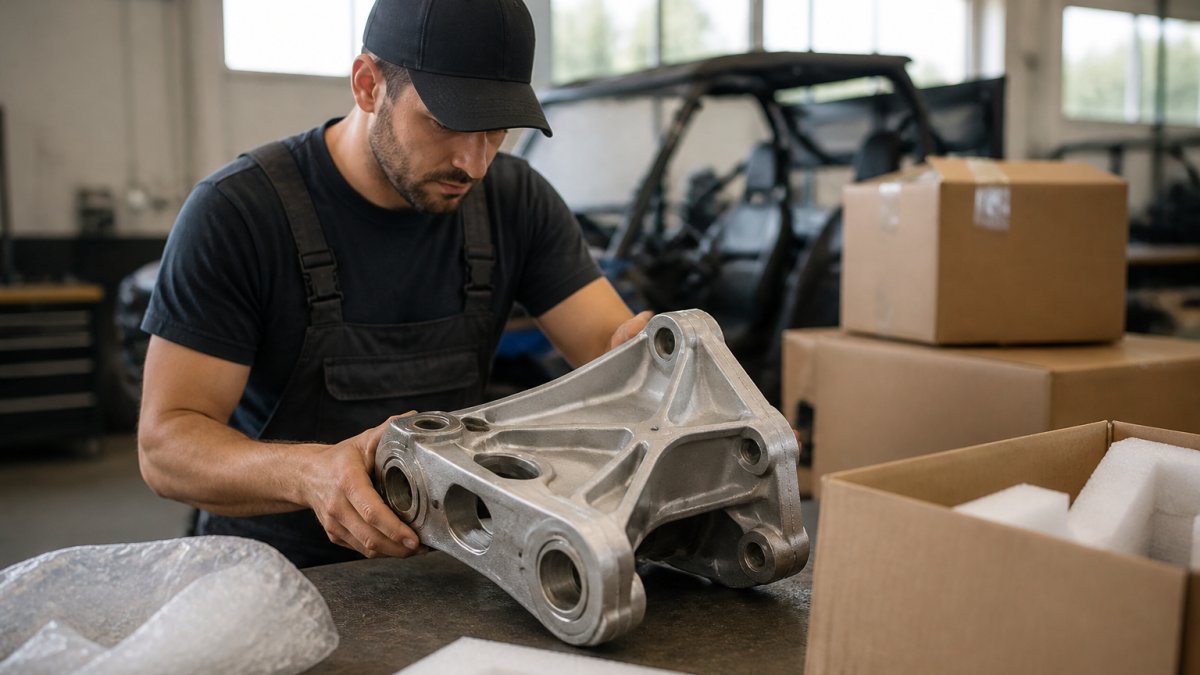
When sellers offer free shipping on heavy parts, they're absorbing real costs, a $150 engine mount with free shipping beats a $130 mount with $35 shipping.
The break-even point depends on weight and distance.
Weight also affects returns. A 15-pound component might cost $25 to $40 to ship back.
The Break-Even Calculation: When Free Shipping Justifies the Wait
Free shipping parts only make sense when the time cost doesn't exceed the money saved. Most buyers never run the numbers, they eyeball the fee and the delivery estimate and guess. Here's a formula that replaces the guess.
The break-even formula
Break-even days = (Shipping cost saved) ÷ (Daily value of having the part)
If the free-shipping option takes fewer extra days than the break-even number, take the free shipping. If it takes more, pay for the faster option.
The hard part is the denominator. "Daily value of having the part" isn't a feeling, estimate it from three inputs:
- Downtime cost, what each day out of service costs you (lost riding days, missed race entries, rental replacement)
- Seasonal multiplier, 1.0 off-season, higher during peak riding season
- Risk of further delay, a small penalty for free-shipping options that route through more handling points
For most recreational riders doing planned maintenance, daily value is effectively $0, you weren't riding those days anyway. For a racer mid-season, it can be $50-$200 per day once you account for entry fees, travel, and lost practice.
Worked example 1: Off-season maintenance
You're replacing a fork rebuild kit in December. Expedited shipping costs $20 and arrives in 3 days; free shipping arrives in 10. The extra wait is 7 days.
- Shipping saved: $20
- Daily value in December: $0 (you're not riding)
- Break-even days: $20 ÷ $0 = infinite
Free shipping wins. You save $20 and lose nothing.
Worked example 2: Mid-season race prep
Same kit, same $20 difference, same 7-day gap, but it's June and you have a race in 5 days.
- Shipping saved: $20
- Daily value in-season: $75 (missed practice, entry fees, travel booked)
- Break-even days: $20 ÷ $75 = 0.27 days
The free-shipping option takes 7 extra days, 26× the break-even threshold. Expedited shipping wins by a wide margin; you'd pay $20 to save 7 days even if daily value were only $3.
Worked example 3: The minimum-order threshold trap
Many sellers offer free shipping only above a minimum order, commonly $49, $75, or $99. That creates a different break-even problem: add filler items to cross the threshold, or pay the shipping fee?
Say the threshold is $75, your cart is $62, and shipping costs $9. You can pay $9 shipping for a $71 total, or add a $15 item you sort of need to reach $77 with free shipping.
Worked example 4: Heavy part, big shipping delta
Heavy parts change the math because the shipping delta is larger. A 15-pound suspension component might cost $45 expedited versus $0 with free economy shipping, a $45 gap.
- Shipping saved: $45
- Daily value off-season: $0 → free shipping wins
- Daily value mid-season: $75 → break-even is 0.6 days; if free shipping takes 5 extra days, expedited wins
The heavier the part, the more the decision hinges on whether you need it this week.
A quick decision checklist
Run through these before choosing free shipping:
- Is the machine down right now? If yes, expedited almost always wins.
- Is there a race, ride, or trip within 14 days? If yes, price expedited before defaulting to free.
- Is the shipping delta under $15? If yes, free shipping usually wins unless you're in a hurry.
- Is the shipping delta over $40? If yes, run the formula, the answer depends on your daily value.
- Would you have bought the filler item anyway? If no, don't add it to hit a threshold.
- Is the part likely to be returned? If yes, factor return postage into the "savings", it may not be savings at all.
The seasonal rule of thumb
A pattern that holds for most riders: free shipping is the default in the off-season, and paid expedited shipping is the default in-season. The fee doesn't change with the calendar, but the value of your time does.
Ordering in November for a spring rebuild? Free shipping is almost always right. Ordering in July with a ride planned for the weekend?
Conclusion
Free shipping parts are worth it when the total cost, item price, delivery time, and return risk, beats your alternatives, and not when hidden markups inflate the item price or delays create bigger problems than they solve.
At Updog Industries, we've eliminated this calculation entirely. We offer 100% free shipping sitewide with no minimum order thresholds, so you never have to choose between free delivery and fast delivery.
Frequently Asked Questions
Are parts with free shipping actually cheaper than competitors charging shipping fees?
Not always. Free shipping parts worth comparing by total landed cost, not just advertised price. A $95 part with free shipping might cost less than a $85 part with a $15 shipping fee, but some sellers inflate base prices to cover free shipping. Check the final checkout total before deciding. Updog Industries offers 100% free shipping sitewide with no hidden costs, so the price you see is what you pay, no surprises at checkout.
How long does free shipping typically take compared to expedited options?
Free shipping usually takes 5-10 business days for standard economy delivery, while expedited options arrive in 2-3 days. The trade-off is real: if you need a part urgently for a race or trail ride, paid expedited shipping may be worth the cost. For routine maintenance or planned upgrades, free shipping's standard parts shipping time is acceptable. Consider your timeline before ordering.
What happens to my return shipping costs if I order a part with free shipping?
Return shipping costs vary by seller. Some absorb return costs for defective items; others charge you to ship it back. This is critical for parts return shipping costs, a free $90 part becomes expensive if return shipping costs $20-30. Check the return policy before ordering. Updog Industries offers 30-day free returns, so you're protected if a part doesn't fit or arrives damaged.
Is free shipping worth it for small parts like air filters or seals?
For small parts, free shipping is usually worth it because shipping costs on lightweight items are low anyway, typically $3-8. A high-flow air filter like the Uni Filter NU-4112ST ($32.98) with free shipping is a better deal than paying extra for expedited delivery. Small parts pile up fast when you're doing a full rebuild, so free shipping on multiple items adds up to real savings.