
Table of Contents
- Essential Tools for Dirt Bike Maintenance: What You Actually Need
- Hand Tools Every Dirt Bike Owner Should Have
- Metric Socket Sets and Wrenches
- Specialty Tools for Engine and Top-End Work
- Tire Maintenance and Chain Tools
- Best Dirt Bike Tool Kit for Beginners
- Dirt Bike Maintenance Checklist and Lubrication Supplies
- How to Perform Basic Dirt Bike Maintenance
- Frequently Asked Questions
Last Updated: September 30, 2026
Essential Tools for Dirt Bike Maintenance: What You Actually Need
Building a proper toolkit with essential tools for dirt bike maintenance separates riders who keep their machines running from those constantly chasing problems on the trail. The reality is straightforward: you don't need everything in a professional mechanic's shop. You need the right essentials for dirt bike maintenance that match your skill level and the work you're willing to tackle yourself.
This guide covers exactly which tools deliver real value, how to organize them for trailside or trackside work, and where quality actually matters versus where budget options work fine. We'll skip the fluff and focus on what riders actually reach for when something needs fixing.
Hand Tools Every Dirt Bike Owner Should Have
Start with hand tools. These form your foundation, and unlike power tools, they won't fail you when the battery dies at the trailhead.
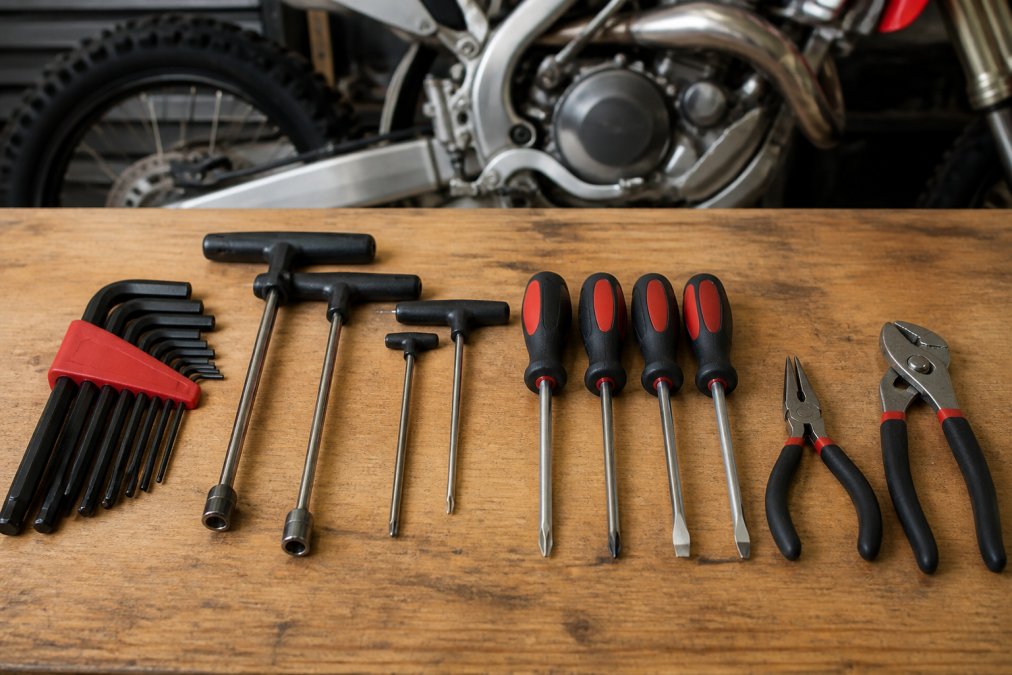
Hex keys and Allen wrenches are non-negotiable. Your dirt bike uses them constantly for airbox covers, brake lever adjustments, and countless fasteners throughout the engine and frame. Get a full set in both metric and SAE sizes. T-handle wrenches give you better use than traditional L-shaped keys, which matters when you're fighting a stuck bolt in the field.
Screwdrivers demand specificity. Most riders buy a cheap multi-bit set and regret it immediately. JIS screwdrivers are what you actually need for Japanese dirt bikes. JIS bits fit the screw head properly, preventing stripped fasteners. Standard Phillips heads slip out too easily on motorcycle fasteners. Get both sizes: stubby screwdrivers for tight spaces and standard-length ones for general work.
Pliers matter more than people realize. You need multiple types: needle-nose pliers for brake line work and clip removal, standard slip-joint pliers for general gripping, and wire cutters for safety wire work if you're doing serious engine rebuilds. Cheap pliers bend and slip. Invest in quality here.
Combination wrenches in both metric and SAE sizes handle your larger fasteners. Most riders need 8mm through 17mm for metric work. These won't break the bank, but buying cheap ones guarantees frustration when you're trying to break a stuck bolt.
The mistake most beginners make is treating hand tools as disposable. Quality tools cost more upfront but actually save money because they don't slip off fasteners, strip screw heads, or bend under pressure. One stripped bolt extraction attempt costs more in frustration and potentially damaged parts than buying proper tools from the start.
Metric Socket Sets and Wrenches
Socket sets are where organization becomes critical. You need metric sockets in standard and deep lengths. Most dirt bike work uses 8mm through 17mm, but get a complete set anyway because you'll eventually work on something unexpected.
Drive size matters here. A 3/8-inch drive handles most fasteners without being too bulky for tight engine spaces. A 1/4-inch drive works for smaller fasteners, but honestly, most riders can skip it unless you're doing detailed carburetor work. A 1/2-inch drive is overkill for dirt bikes.
Quality socket sets from established manufacturers won't slip off fasteners like budget options do. Slipping sockets round off bolt heads, creating stripped bolt extraction problems that spiral into bigger issues. This is one area where saving money creates expensive consequences.
Torque wrenches are essential if you're doing any top-end work or engine rebuilds.
Specialty Tools for Engine and Top-End Work
This section separates casual maintenance from serious builds. If you're only doing routine maintenance, skip ahead. If you're rebuilding top ends or doing engine work, these tools are non-negotiable.
Tire Maintenance and Chain Tools
Tire irons let you change tires without destroying the rim. You need at least three, and they should have rounded edges to prevent pinching tubes. Cheap tire irons have sharp edges that puncture tubes during installation, creating frustration and wasted tubes.
K&N Air Filter 02-03 Yamaha YFM660 →
Best Dirt Bike Tool Kit for Beginners
Starting riders should focus on hand tools before investing in specialty equipment. You won't use a flywheel puller for routine maintenance, so don't buy one yet.
A beginner toolkit includes:
- Complete hex key set (metric and SAE)
- T-handle wrenches for better use
- JIS screwdriver set (not Phillips)
- Basic pliers set (needle-nose, standard, wire cutters)
- Combination wrenches (8mm-17mm metric)
- 3/8-inch socket set with ratchet
- Torque wrench (10-150 foot-pounds)
- Tire pressure gauge
- Tire irons (set of three)
- Basic lubricants and cleaning supplies
| Tool Category | Essential for Beginners | When to Upgrade |
|---|---|---|
| Hand tools | All of them | When you damage tools from overuse |
| Socket set | 3/8-inch metric drive | Add 1/2-inch drive for larger fasteners |
| Torque wrench | 10-150 foot-pound range | Only if doing engine work |
| Tire tools | Pressure gauge, irons | Tire machine if changing tires frequently |
| Specialty tools | None needed yet | As you tackle more complex jobs |
Dirt Bike Maintenance Checklist and Lubrication Supplies
Preventative maintenance keeps your bike reliable and prevents expensive failures. A maintenance schedule mapping system helps you stay organized about what needs attention when.
Pre-ride checks take fifteen minutes and prevent most trail problems:
- Check tire pressure (cold, before riding)
- Inspect brake pads for wear
- Verify chain tension and lubrication
- Check all fasteners for tightness
- Look for fluid leaks
- Test brakes and clutch lever feel
Weekly maintenance (if riding multiple times per week):
- Clean or replace air filter
- Inspect chain for damage
- Check brake fluid level
- Verify tire condition
Monthly maintenance:

- Deep clean the bike
- Inspect suspension components
- Check all fasteners throughout the bike
- Verify brake pad thickness
- Inspect sprockets for wear
How to Perform Basic Dirt Bike Maintenance
The common pitfall is assuming your bike is fine without checking. Dirt bikes work hard, and fasteners loosen constantly from vibration. Chains stretch and wear. Brake pads thin. A five-minute weekly inspection catches these issues before they become expensive problems.
Frequently Asked Questions
What tools are essential for dirt bike maintenance?
Start with metric socket sets, combination wrenches, hex keys, screwdrivers (including JIS-style for Japanese bikes), pliers, and T-handle wrenches. Add a torque wrench for critical fastener work, tire irons for tire changes, a chain breaker for chain service, and a spark plug wrench. For trailside repairs, keep penetrating oil, degreaser, and waterproof grease on hand. Most riders benefit from a dirt bike stand or lift to access the underside safely during maintenance.
What should be included in a best dirt bike tool kit for beginners?
A beginner's kit should contain basic hand tools: hex keys (allen wrenches), metric socket set (10-19mm), combination wrenches, screwdrivers, pliers, and wire cutters. Add a torque wrench set to proper fastener specs, tire irons, and a pressure gauge for routine checks. Include cleaning supplies like degreaser and shop rags, plus penetrating oil for stuck fasteners. Updog Industries carries quality air filters starting at $21.95 that beginners should replace regularly, a two-stage foam design cleans easier and improves airflow compared to paper filters.
How often should I perform maintenance on my dirt bike?
Pre-ride checks happen before every outing: inspect tire pressure, chain tension, and brake function. Weekly or every 5 hours of riding, clean or replace the air filter (especially in dusty conditions), check fastener tightness, and inspect the chain for wear. Monthly maintenance includes a full fluid check, spark plug inspection, and brake pad evaluation. Engine rebuilds and major work depend on riding intensity but typically occur every 40-80 hours. A maintenance schedule mapped to your riding frequency prevents costly failures.
What are the most common dirt bike maintenance mistakes?
Riders often neglect air filter cleaning, leading to poor carburetion and reduced power, especially in dusty riding. Over-tightening fasteners without a torque wrench strips threads and damages components. Skipping chain maintenance causes accelerated wear and potential failure. Using incorrect fastener sizes or mixing metric and standard tools leads to bolt damage. Not checking torque specifications on critical fasteners like axle nuts and clutch bolts creates safety hazards. Finally, ignoring routine pre-ride inspections catches problems too late when they become expensive repairs.
What's the difference between trailside and garage maintenance tools?
Trailside tools prioritize compact size and emergency capability: hex keys, T-handle wrenches, tire irons, chain breaker, and penetrating oil fit a small pack. Garage maintenance uses full-size metric socket sets, impact drivers, specialized pullers (flywheel, clutch holding tools), a dirt bike stand, and degreaser for thorough cleaning. Torque wrenches belong in the garage where precision matters; trailside work focuses on temporary fixes to get home. Organize trailside tools in a waterproof bag; garage tools need proper storage to prevent rust and loss.
Do I need a torque wrench for dirt bike maintenance?
Yes, a torque wrench is essential for critical fasteners. Axle nuts, clutch bolts, flywheel puller bolts, and engine case fasteners all have specific torque specifications, usually 20-80 Nm depending on the component. Over-tightening strips threads; under-tightening causes fastener loosening and failure. A beam-style or click-type torque wrench costs $30-80 and prevents expensive damage. Always consult your service manual for exact specifications; different models vary significantly in fastener requirements.
What air filter should I use for my dirt bike?
Choose a two-stage foam filter for superior dirt-stopping and airflow. Uni Filter and K&N offer reusable options that separate for thorough cleaning and re-oiling. For example, the Uni Filter NU-2480ST ($32.22) fits Suzuki DR-Z400 and Kawasaki KLX400R models across 2000-2024. Two-stage designs provide coarse outer layers that catch large debris and fine inner layers that trap microscopic dust. Foam filters are washable indefinitely if maintained correctly, making them more economical than disposable paper filters while improving engine performance.